


Architectural Spaces: A Stage for Performing Etiquette
written by Yamamoto Riken
Recently, some politicians have been behaving particularly badly. Their language is foul. They don’t respond properly to questions. They mock reporters who interview them. They intimidate them. They don’t even try to hide their bad manners in front of television cameras. I think this is fatal for a politician, but it seems that this attitude is greeted with applause from some people.
This is because some people believe that foul language and bad manners are proof that a politician is speaking frankly. If they are speaking honestly about essential matters, there is no need to be reserved. There is no need for pretense; some people think that their rough speech is the result of frankness, that this person is a trustworthy colleague.
Who are these “some politicians” and “some people”? To whom is this rough language directed? You can see it if you look. They are only speaking to their own circle of friends. They have no regard for the diverse people living in their local communities on the other side of the TV camera, or for those with opposing views. The language used by these ill-mannered politicians is directed at their own circle of friends behind them. They use particularly rough language because they want to impress the circle of friends behind them. Because they want to be part of that circle. Because they are pandering to those friends. They believe that this is the proper way to be a politician.
And it seems that this is not just the sensibility of a few, but has now become a sensibility for many of us. Any discussion, not just political discussions, is ultimately a discussion to impress those in their circle, so there is absolutely no need to be considerate of anyone other than those in their circle. From these ill-mannered politicians to power harassment in the workplace, this structure of disrespect for those in the discussion is what we currently see in our own discourse space.
In the ancient Greek assemblies (citizens’ assemblies), etiquette was established: “Speak with consideration for others.” Only those who understood the proper etiquette for speech were allowed to participate in the assemblies. There, aesthetic etiquette was required along with the content of the discussion. Through gestures and choice of words, each party understood that “I am here because I am respected.” “This place” was a public space.
To debate was to perform the aesthetics of etiquette in a public space. This ancient Greek tradition, that to debate was to perform the aesthetics of etiquette, has long been passed down as a tradition in European society. American sociologist Richard Sennett says, It is said that this reached its peak in Paris in the 18th century.
18th century Paris was the age of salon culture. Salons hosted by the wives of influential aristocrats were places for study sessions to acquire new knowledge, and those who attended these salons competed with each other to prove that they were exceptional researchers with superior knowledge.
Paris salons looked like this picture (illustration on page 9 of this book). Everyone wore blonde or silver wigs and their clothes were flashy. The man lecturing in a bright red jacket and culottes (short pants) of the same color was Voltaire. Voltaire While he is famous as one of the Enlightenment thinkers of the 18th century, his ideas were honed through the discussions at these salons.
People of that era could tell what kind of person a person was at a glance by their wigs and clothing. This is how the wealthy aristocrats and bourgeoisie dressed as they walked the streets of Paris. Appearance was important, as it was customary to always reveal who one was in public spaces. “In the street, people behaved and dressed as if other people knew who they were” (Richard Sennett, “The Disappearance of the Public,” translated by Kitayama Katsuhiko and Takashina Satoru, Shobunsha, 1991, p. 104).
In 18th-century European society, human activity and speech were governed by established etiquette. These etiquettes required special spaces in which they could be performed.
Architects were well aware of the etiquette that would be performed there, and they designed their architectural spaces for those etiquettes. In other words, architectural spaces were designed as stages for etiquette. Paintings and sculptures were essential tools for decorating the stage, so architects had to have sufficient knowledge and skill in these fields as well. 18th-century architecture was an era of stylism. Exteriors were created by imitating architectural styles such as ancient Greece, Rome, and Gothic. These facades were like stage sets for the urban space. Creating such architecture was the role of the architect. It was precisely for this reason that the people who stood on the stage of the city were fully aware that they were actors on that stage.
The body was adorned with wigs, clothing, and makeup, and this adorning allowed one to perform etiquette appropriate to the architectural or urban space. Etiquette is a deliberate performance. To perform, one must have the eyes of others to watch the performance. Etiquette meant being conscious of the eyes of others and conforming to their expectations within the space in which it was performed.
Salon discussions were a place to pay respect to the aristocratic women who presided over the salons, and to persuade others without offending them. It was a stage for this purpose. Jean-Jacques Rousseau, a central member of these salons, was uncomfortable with this atmosphere and criticized them, saying that “people were forced to behave like actors.” However, in reality, the conversations there were ones in which people were considerate of what others said and a sense of respect for others was fully evident. “The first thing that captivates one is the recognition of knowledge and reason in the conversation. The tone of the conversation is fluent and natural, neither heavy nor frivolous, knowledgeable without pretense, lively without boisterous, polite without pretense, charming without pretense, humorous without ambiguity.” (Jean-Jacques Rousseau, “The New Héloïse II,” translated by Yasushi Masao, Iwanami Bunko, 1960, p. 83; Akagi Shozo and Akagi Fumiko, “The Intellectual History of the Salon: From Descartes to the Enlightenment,” Nagoya University Press, 2003, p. 309).
Rousseau criticized this kind of conversation, which was based on concern for others, as being tantamount to hiding one’s true feelings and “defending a lie skillfully” (ibid., p. 84), but people at that time could not communicate their thoughts to others unless they followed this etiquette. This was conversation in a public space. And this etiquette of conversation must have been supported by the way of behaving “like an actor” and was not unrelated to the architectural space of formalism. In the salon, too, people behaved as actors on a stage, and the audience participated as listeners on the stage. Rousseau, who criticized the salon, had also won high acclaim as a salon performer (at the same time, offstage, in his private life, Rousseau was also a first-class actor in scandals).
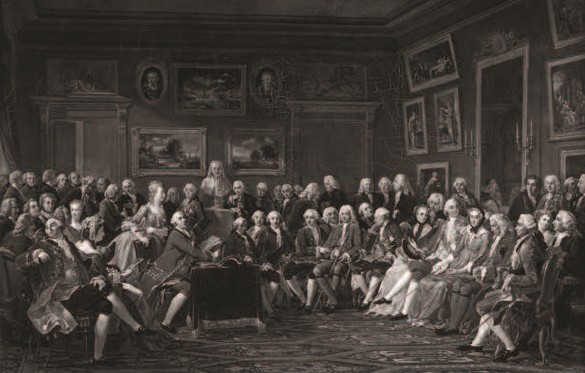
Alexandre-Gabriel Lemonnier, First Reading of Voltaire’s “The Chinese Orphan,” held at Madame Geoffrin’s salon, c. 1755 (Photo courtesy of WPS)
However, the great industrial transformation of the 19th century fundamentally altered these urban spaces. Huge numbers of people flocked to major cities, including Paris and London, in search of work. These influxes were completely unrelated to the urban customs of the past. They arrived simply to carry out the mass production system created by the new industrial structure. They were called laborers. Marx coined the term “labor power” to describe the value of these workers’ existence. Labor power is not the labor itself, but the potential productive capacity of an individual.
“By labor power, we understand the sum total of the physical and mental capacities present in one human body, that is, in one living person” (Karl Marx, Capital, Vol. 1, Part 1, translated by Imamura Hitoshi, Mishima Kenichi, and Suzuki Tadashi, Chikuma Shobo, 2005, p. 248).
In other words, labor power is the standard by which a person’s value is judged when their capacity for productivity is measured. Productive capacity is measured in time. Marx believed that the productivity that a worker can achieve by working a certain amount of time in the production process of goods is the same for everyone in a mass production system. This is labor power. This was a groundbreaking idea. By considering one living human being as a unit of labor power, that body becomes interchangeable with anyone else’s. My body is exchangeable with someone else’s. This is the essence of the concept of labor power.
Since the Industrial Revolution of the 19th century, the world has come to conform to Marx’s standards of human value. This has changed cities and architecture as well. Instead of urban and architectural spaces for the performance of etiquette, cities became places where efficiency for industrial production was the top priority. This changed the entire urban environment and even the way architecture was constructed.
Architectural spaces, which had previously been like stages, changed to spaces based on function. This is what has shaped today’s urban spaces. Japan’s cities of today are cities where this has reached its peak.
In urban spaces that have lost their stage-like quality, all the people who live there are interchangeable. No one plays anyone. You must not pry into who you are. You must not look at others. You must not listen to the voices of others. This is the urban etiquette that we have now implicitly embodied.
In such urban spaces, politicians too have lost track of what role they should play.
The ability to determine what role one should play in public space is called judgment. Immanuel Kant said that a lack of judgment is hopeless. “A lack of judgment is what is called stupidity in the first place, and this lack is completely insurmountable. It is nothing more than dullness of mind, or a lack of the proper level of intelligence and the concepts [words] proper to intelligence, which can be greatly improved through learning. … Even in such cases, the gift of judgment is generally lacking” (Immanuel Kant, Critique of Pure Reason, Vol. 1, translated by Ishikawa Fumiyasu, Chikuma Shobo, 2014, pp. 221-222). According to Immanuel Kant, particularly badly behaved politicians lack judgment. While intelligence can be compensated for through learning, a lack of judgment is insurmountable. Kant is strict. He is saying that such people should leave public spaces.
Japan’s urban spaces today are no longer public spaces. In other words, they are no longer spaces in which public etiquette can be practiced. Residents who live there must behave as if they have lost their judgment.
References:
Akagi Shozo and Akagi Fumiko, “The Intellectual History of the Salon: From Descartes to the Enlightenment,” Nagoya University Press, 2003
Immanuel Kant, “Critique of Pure Reason, Vol. 1,” translated by Ishikawa Fumiyasu, Chikuma Shobo, 2014
Karl Marx, “Das Kapital,” Vol. 1, Vol. 1, translated by Imamura Hitoshi, Mishima Kenichi, and Suzuki Tadashi, Chikuma Shobo, 2005
Jean-Jacques Rousseau, “The New Héloïse, Vol. 2,” translated by Yasushi Masao, Iwanami Bunko, 1960
Richard Sennett, “The Loss of the Public Sphere,” translated by Kitayama Katsuhiko and Takashina Satoru, Shobunsha, 1991
 City Beautiful
Leave a comment