

岡部明子 「悪 vs. 正義」の構図を超えて ベネズエラの「コムーナ」が問う人間の尊厳と民主主義:朝日新聞GLOBE+
The Asahi Shimbun Globe+ World Now Updated: January 8, 2026 Published: January 8, 2026
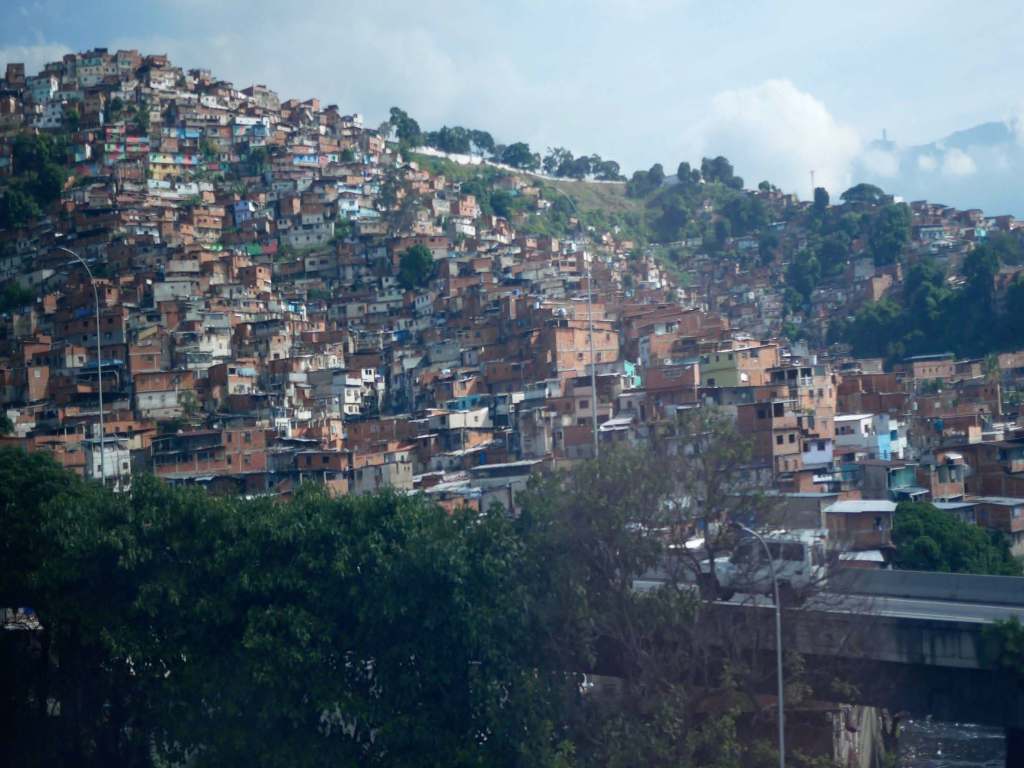
Barrios are low-income areas in the capital, Caracas. Approximately half of the metropolitan population lives in houses densely clinging to steep slopes. Photo by Taiki Aiba, Caracas, Venezuela, November 2024.
On January 3, 2026, shocking news of the U.S. military attack on Venezuela and the arrest of President Maduro spread around the world. Just two months before this dramatic event, Professor Akiko Okabe (Environmental Studies) of the University of Tokyo attended the World Barrio Conference in Caracas, just before military pressure intensified. Okabe, who considers the nature of democracy through urban development around the world, witnessed what she saw in Caracas, contrary to the image of dictatorship and economic collapse. People branded with poverty were vibrantly carving out their own paths through local communities known as “comunas.” We present Okabe’s contribution.
Author Profile
Akiko Okabe, Professor, Graduate School of Engineering, The University of Tokyo Ph.D. in Environmental Studies, 2005. Served as an associate professor at Chiba University in 2004, a professor at the University of Tokyo Graduate School of Frontier Sciences in 2015, and other positions before assuming her current position in 2025.
She has been an expert member of the UN-Habitat Housing Working Group since 2025 and a member of the expert group for the formulation of the UN New Urban Agenda in 2016. She has developed architectural practice projects in informal settlements in Asia and South America (recipient of the Holcim Awards 2014 and other awards). His major works and translations include Housing by the People (1976, Turner; co-translated in 2025), Megacities 6: Densifying Megacities (edited and co-authored, 2017), Barcelona (2010), Sustainable Cities: The EU’s Regional and Environmental Strategy (2003), and Euroarchitects (1998).
Beyond the “Evil vs. Good” Strategy: Venezuela’s “Comuna” Questions Human Dignity and Democracy by Akiko Okabe
In November 2025, just before US military pressure intensified and travel to and from Venezuela was cut off, I accompanied architect Riken Yamamoto to the World Barrio Congress held in the capital, Caracas.
Approximately 3,000 people proudly gathered at the Caracas Grand Theater, the venue for the conference. They were residents of the “barrios,” neighborhoods on the outskirts of cities where many low-income residents live.
Barrios are the kind of environment that comes to mind when you think of slums, and are similar to the neighborhoods known as “favelas” in neighboring Brazil. Approximately half of the population of the Caracas metropolitan area is said to live in these barrios.
Major media outlets report that Venezuela’s long history of anti-American leftist dictatorship has led to economic collapse and social unrest. An estimated 8 million people have fled the country, and the poor living in the barrios are thought to be particularly pushed to their limits.
Gondolas Change Everyday Life
I wondered what the current situation was like. I visited the barrios prepared to explore, but I was pleasantly surprised by what I saw. Colorful murals were painted throughout the streets, creating a cheerful atmosphere.
Many barrios are built on hillsides that were left untouched by urban development, due to the difficulty of infrastructure development. As a result, transportation access was a major challenge. On the flipside, the winding, hilly alleyways are captivating, and visitors can enjoy sweeping views of the entire city below from the top.
The situation changed in 1999 with the rise of the left-wing populist Chavez administration, the predecessor of Maduro’s government. Gondolas (urban cable cars) were introduced as public transportation, dramatically improving access.
San Agustin, one of the first areas to adopt gondolas in 2010, is close to the city center and is now a neighborhood proud of its “barrio culture.” At dusk, the area teems with young people, and men and women of all ages can be seen dancing all night to salsa rhythms.
In Petare (population approximately 400,000), said to be Latin America’s largest slum, shabby houses made of reddish-brown thin brick cling to a steep 40% slope. Since the Maduro administration took over, stairs have been installed in the area.
“I’m glad we can now travel safely. Although, climbing and descending the stairs is getting more and more tiring,” said an elderly woman as she slowly made her way up the stairs.
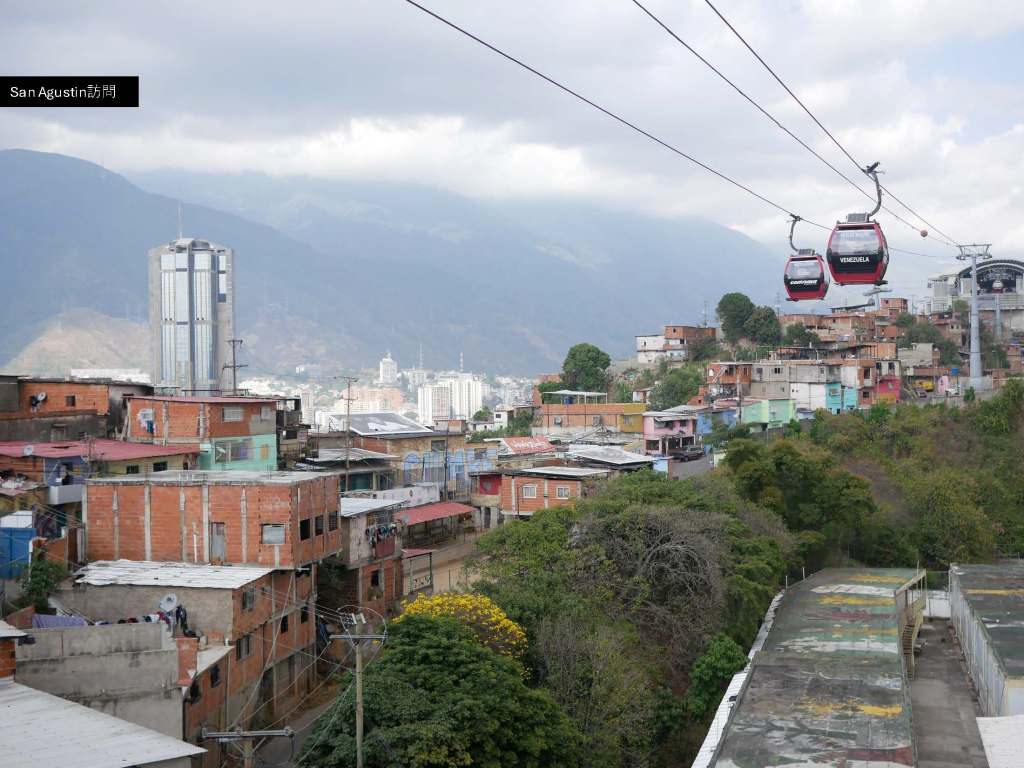
サA gondola introduced in the San Agustin neighborhood. November 2025, Caracas, Venezuela. Photo by Aiba Taiki.
A Community-Led “Grand Experiment”
The main actors at the World Barrio Congress I attended were the local communities active in their own barrios. They operate as self-governing community organizations called “comunas.”
At the conference, representatives from the San Agustin neighborhood comuna “100% San Agustin” and the Petare neighborhood comuna “Vamos con Todo (Let’s Do Anything Together)” took the stage to present their initiatives. Each community wore matching T-shirts and held up banners. With singing and dancing, it was a Latin-style celebration that united the audience.
*What is a comuna?
A self-governing community organization that was institutionalized in Venezuela after the Chavez administration. It is attracting attention as a system that enables residents to take the lead and address various issues facing local communities, such as living environment, education, and healthcare, in an integrated manner.
According to UN statistics, currently, 1 billion people, or more than 10% of the world’s population, face housing issues similar to those faced by the Venezuelan barrios.
Since the 1950s, governments around the world have provided public housing, but the effectiveness of this has been limited. In recent years, these areas have come to be called “informal settlements,” and efforts have been made to legalize rights to land and housing in an effort to resolve these issues through market channels. However, there are limits to what can be achieved through external improvement.
In contrast, Venezuela’s comunas allow communities to take the lead and address local issues, such as the physical environment, education, and healthcare, in an integrated manner. It is these comuna systems that create the momentum for the people who live there to move forward.
Globally, community-focused initiatives have been attempted in various places, including Brazil’s participatory budgeting (since the late 1980s), the Philippines’ community mortgage program, and Indonesia’s kampung (village community) improvement projects that utilize self-governance.
However, careful efforts that respect the autonomy of poor communities take time. In a world where neoliberal economic development is accelerating, such efforts have felt like small boats thrown into the ocean, and often left people feeling powerless.
Meanwhile, in Venezuela, isolated from the rest of the world, a “grand experiment” has resulted in a “miracle.”
People who were once stigmatized as poor can now proudly say, “We are making our own decisions and carving out our own paths in life.”
This has been made possible largely by the government’s drastic shift toward supporting the autonomy and self-governance of comunas.
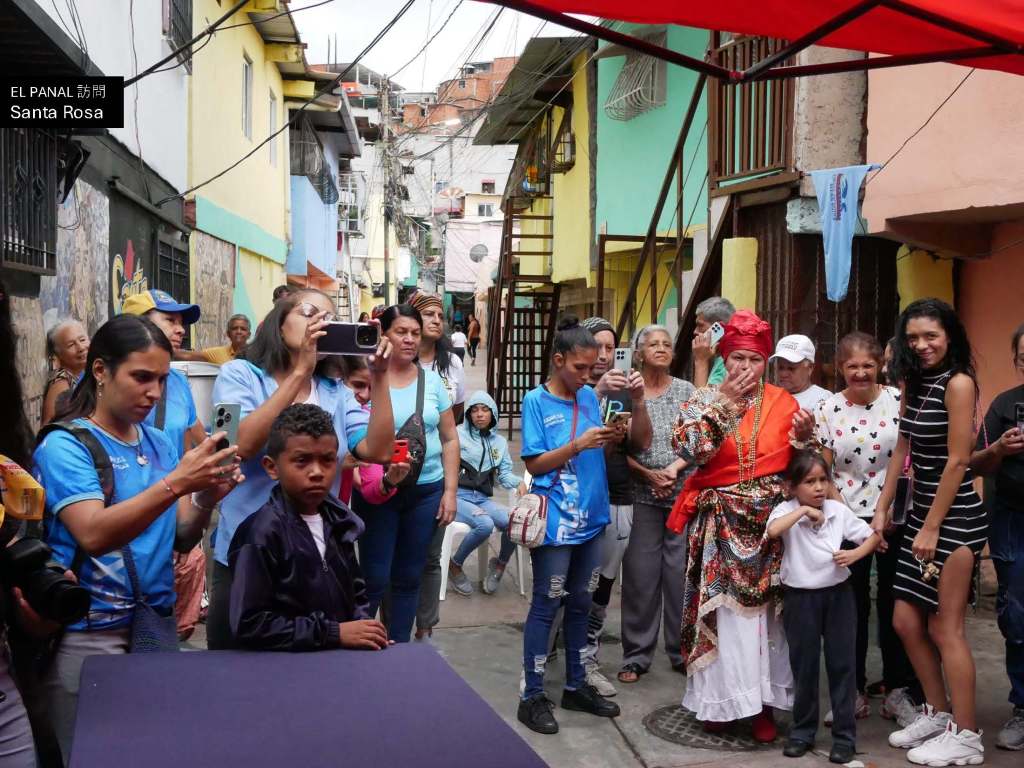
Barrio residents – November 2024, Caracas, Venezuela, photo by Aiba Taiki
System Supporting Comunas
Comuna autonomy gradually developed following the establishment of relevant legislation during the Chavez administration, and finally began to bear fruit under the Maduro administration that succeeded them in 2013. Separate from the hierarchical governing structure of the national, state, and municipal governments, the approximately 3,600 comunas nationwide propose projects. A system was created in which these proposals are selected by a national council and then allocated to the government.
Comuna-related budgets are known as “comuna route budgets.” Initially, they accounted for only a few percent of the national budget, but the Maduro administration has sought to significantly increase this to several tens of percent.
Because barrio residents build and live on land that has not yet been developed, they lack security of land and home ownership and face limited social access. Therefore, the government began issuing certificates for informally occupied land, stabilizing their livelihoods.
When I see the comunas, I can’t help but think about human dignity.
“Eliminate poverty and ensure a dignified life for all” is a global slogan, but human dignity cannot be achieved simply by escaping economic poverty.
Regardless of economic wealth, isn’t human dignity found in the process of identifying challenges and deciding for oneself how to address them?
Even if people are economically prosperous, is human dignity possible without the “process of self-determination” experienced by the comuna people? In fact, they are posing a fundamental question to the wealthy, who only value the prosperity of the market economy.
Today’s Venezuela is generally understood in terms of the “evil” of the Maduro dictatorship with ties to drug cartels and the “justice” of María Corina Machado, an opposition leader who advocated “democratization” and was awarded the Nobel Peace Prize.
Indeed, the legal system related to the comunas has not undergone the democratic process of constitutional reform. The Maduro administration’s path is one of empowering the people and realizing participatory democracy. However, it’s understandable that political participation is limited to the comuna system, infringing on freedom of thought and expression.
Furthermore, in order to enter the comuna route budget arena, full support for the current administration is a prerequisite. The issuance of land deeds to barrio residents has also been expedited through administrative procedures alone, raising concerns about infringement of property rights and other issues that conflict with democracy.
Historical Background
Since its democratization in 1958, Venezuela has been governed by a series of pro-American governments and has been known as a “model student of democracy” in South America. In the 1980s, as oil, boasting the world’s largest reserves, became the backbone of the national economy, U.S. oil majors and a small ruling elite monopolized interests. It’s no wonder that the country is called “America’s backyard.”
These vested interests have rapidly widened the gap between the wealthy and the poor. The collapse of oil prices in 1983 sparked discontent among the lower classes, who were effectively excluded from the democratic government of the time, leading to the Caracas Riots in 1989.
Supported by the poor, former President Chavez’s anti-American, leftist government was born in 1999 under the slogan “Bolivarian Revolution.” Bolivar refers to Simon Bolivar, the hero who led South America to independence, starting with Venezuela.
A charismatic leader, Chavez advocated “21st-century socialism,” nationalized strategic infrastructure, and, after surviving a 2002 anti-government coup, embarked on major constitutional revisions. He legally established “people’s power,” envisioned a democracy in which the poor could participate as key players, and established the “comuna” system. At the same time, he proposed a new concept of ownership and made it possible for the president to be re-elected, sparking growing concern both at home and abroad about his authoritarianism.
Following Chavez’s death in 2013, Vice President Maduro became president. Falling oil prices, coupled with economic sanctions from the United States and other countries, led to hyperinflation of tens of thousands of percent, and as the wealthy and then the middle class fled overseas, socialist policies became more radical and the Maduro administration further strengthened its anti-American stance. Maduro was elected in both the 2018 and 2024 presidential elections, but anti-government opposition parties claim the elections were not fair, and many countries do not recognize President Maduro as head of state.
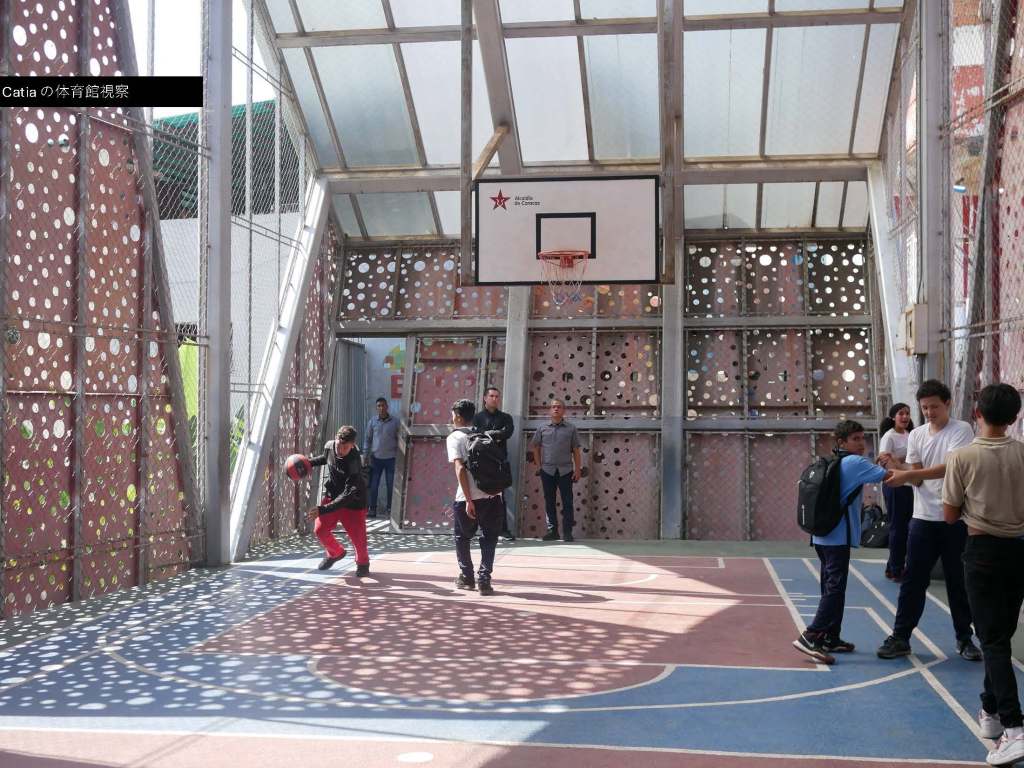
A gymnasium built in a barrio to promote the healthy development of young people. February 2025, Caracas, Venezuela. Photo by Aiba Taiki.
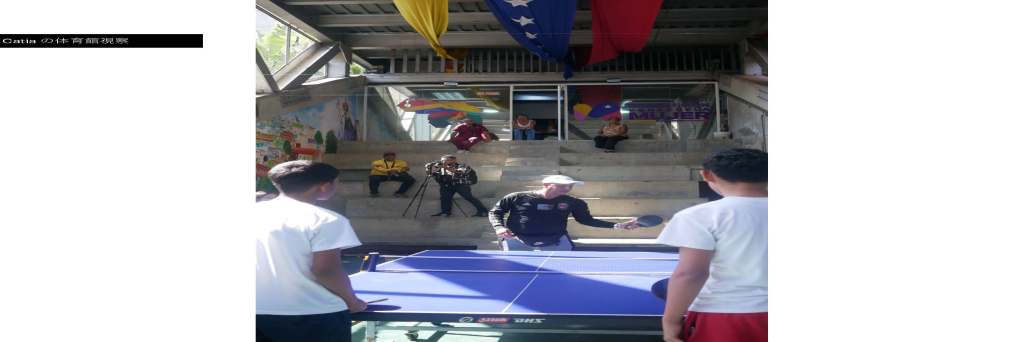
A gymnasium built in a barrio for the healthy development of young people. February 2025, Caracas, Venezuela. Photo by Aiba Taiki.
Grassroots Democratic Movement vs. Formal Democratization
However, if we put ourselves in the shoes of the barrio residents and look at the world from their perspective, we see a conflict between the democratic movement of the economically poor barrio people and the elite democracy of the wealthy.
In other words, the conflict is between the grassroots democratic movement and formal democratization. Doesn’t the neoliberal democratization advocated by the opposition risk a return to elite democracy for the wealthy?
Looking back at history, the discontent of people shunned from democracy sparked the 1989 Caracas riots, and the government turned its guns on them. Could it be that the anger that arose from this was what gave rise to President Chavez and fueled the 25-year continuity of his left-wing populist regime, which has become increasingly authoritarian and globally isolated? I believe that the autonomous process that has finally begun to emerge within the comunas embodies the ideals for global urban poverty alleviation.
What would become of them if the revolutionary spell advocated by the far left were to be broken? By well-intentionedly supporting neoliberal democratization, we could be encouraging the comuna movement to be reverted to a theory of “personal responsibility” by the poor.
The democratic movement growing within the comunas teaches us the importance of driving democracy as a process that upholds “human dignity.”
Though this is a movement that has gained momentum due to unique political conditions, if the World Barrio Congress can connect with various informal settlements around the world, it has the potential to develop into a major movement originating in the Global South.
Beyond that, there lies a glimpse of hope that it could even change the values of the Global North (a world centered around developed countries).
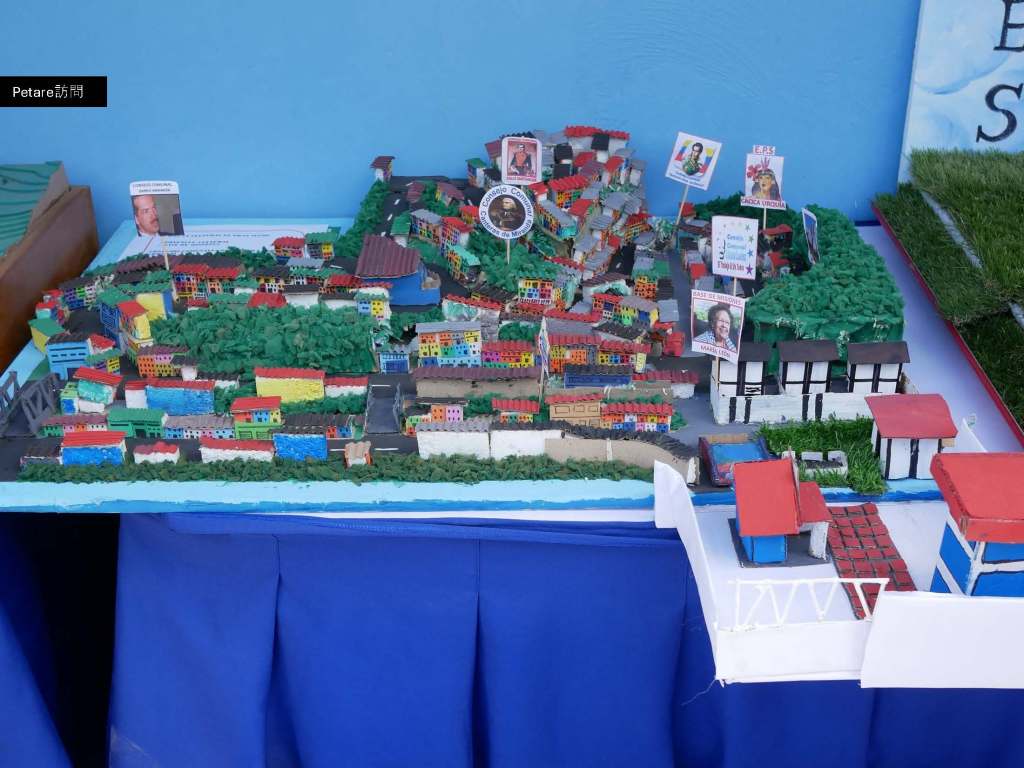
A model of the Petare district created by residents. February 2025, Caracas, Venezuela. Photo by Aiba Taiki.
Akiko Okabe, Professor, Graduate School of Engineering, The University of Tokyo
Ph.D. in Environmental Studies, 2005. Served as an associate professor at Chiba University in 2004 and a professor at the Graduate School of Frontier Sciences, The University of Tokyo, in 2015. Has been in her current position since 2025. She was an expert member of the UN-Habitat Housing Working Group from 2025 and a member of the expert group for the formulation of the UN New Urban Agenda in 2016. She has developed practical architectural projects in informal settlements in Asia and South America (receiving the Holcim Award in 2014, among other awards). Her major publications include Housing by People (1976, co-translated by Turner, 2025), Megacities 6: Densifying Megacities (editor, 2017), Barcelona (2010), Sustainable Cities: EU Regional and Environmental Strategies (2003), and Euroarchitects (1998).
 City Beautiful
Leave a comment